Lithological diversity in the geologic-archeological context in Jicotea, Ciego de Ávila province, central Cuba
Article Sidebar
Main Article Content
Abstract
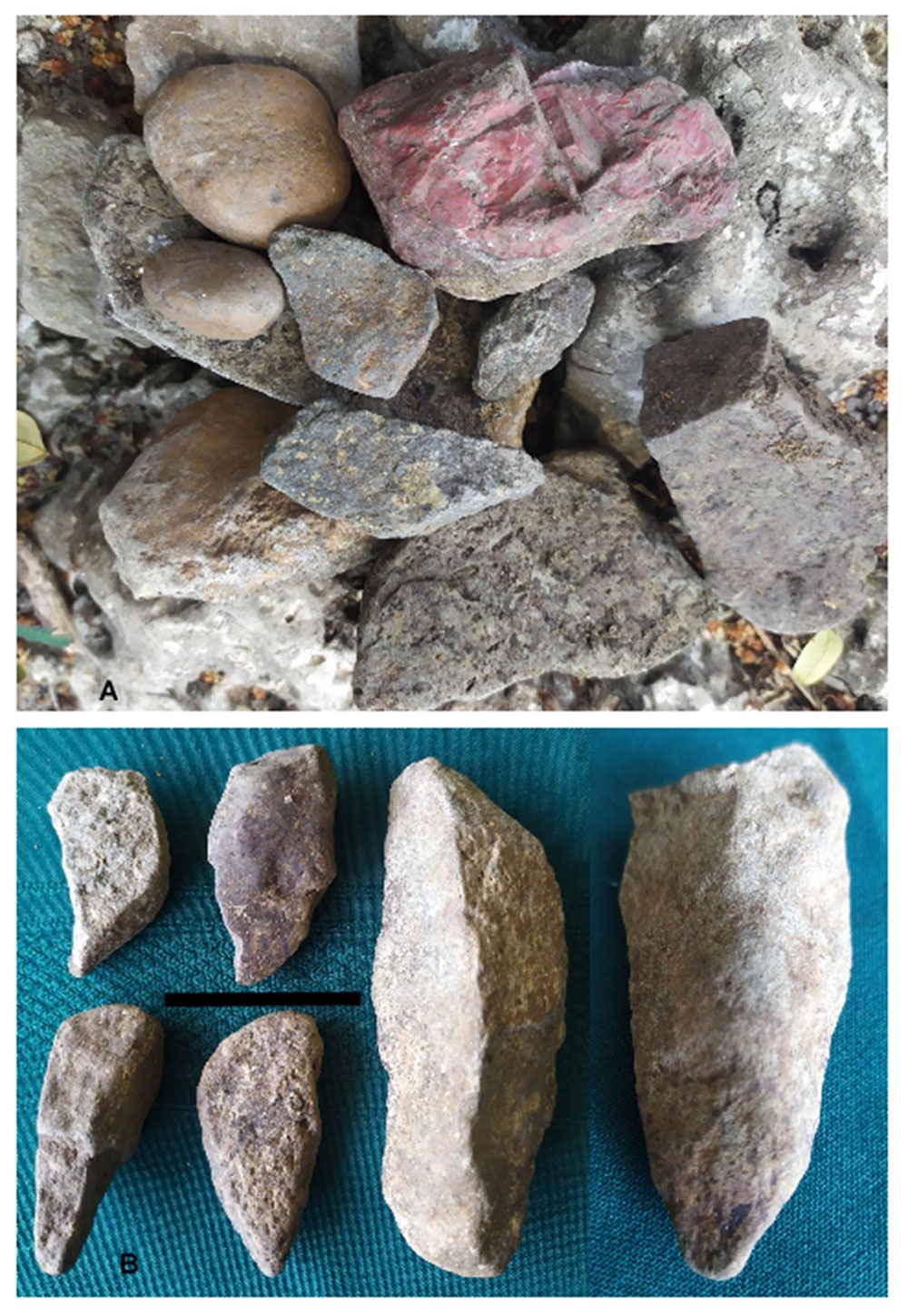
At the "Tasa de Oro" farm, located 800 m south of the town of Jicotea (Ciego de Ávila province, central Cuba), a multidisciplinary study was conducted to characterize the lithological diversity in a context with archaeological evidence. The area, underlain by the Arabos Formation (Miocene) over Cretaceous volcanic rocks, contains alluvial materials from the Jicotea River and signs of primitive human activity. Through rescue collections and surveys in riverbeds and cultivated soils, supported by the local community, volcanic lithologies (tuffs, ignimbrites, dacites), siliceous rocks (jasper, agate, chalcedony, crystalline and amorphous cuarz), and sedimentary rocks (limestone and radiolaric silicite) were identified. The discovery of opalized fossil wood (xylopalus), likely of Cretaceous age, transported by alluvial flows from the north, stands out. Two lithic tools (grinding slab and pestle) made of ignimbrite were recovered, along with lithic workshop remains (cores and flakes) of opal, radiolaric silicite, and silicified bioclastic limestone; the latter two are exotic to the local substrate, indicating anthropic transport from distant regions. Karstic elements such as pisolites were also collected. The lithic industry is attributed to the Middle Stage of Pre-tribal Appropriators Social Economic Formation. This is the first report of an archaeological site in the region, with a Mesolithic human presence. The study reveals the interaction of natural and anthropic processes in the local lithological diversity and opens a perspective for archaeological and paleontological researches in central Cuba.
Article Details

This work is licensed under a Creative Commons Attribution-NonCommercial 4.0 International License.
Those authors who have publications with this journal accept the following terms of the License Attribution-NonCommercial 4.0 International (CC BY-NC 4.0):
You are free to:
- Share — copy and redistribute the material in any medium or format
- Adapt — remix, transform, and build upon the material
The licensor cannot revoke these freedoms as long as you follow the license terms.
Under the following terms:
- Attribution — You must give appropriate credit, provide a link to the license, and indicate if changes were made. You may do so in any reasonable manner, but not in any way that suggests the licensor endorses you or your use.
- NonCommercial — You may not use the material for commercial purposes.
- No additional restrictions — You may not apply legal terms or technological measures that legally restrict others from doing anything the license permits.
The journal is not responsible for the opinions and concepts expressed in the works, they are the sole responsibility of the authors. The Editor, with the assistance of the Editorial Committee, reserves the right to suggest or request advisable or necessary modifications. They are accepted to publish original scientific papers, research results of interest that have not been published or sent to another journal for the same purpose.
The mention of trademarks of equipment, instruments or specific materials is for identification purposes, and there is no promotional commitment in relation to them, neither by the authors nor by the publisher.
How to Cite
References
Belmustakov, E., Dimitriva, E., Ganev, M.; Haydutov, I., Kostadinov, I., Ianev, S., Ianeva, J., Kojumdjieva, E., Eoshujarova, E., Popov, N., Shopov, V., Tcholakov, P., Tchounev, D., Tzankov, T., Cabrera, R., Díaz, C., Iturralde, M. y Roque, F. (1981). Geología del territorio Ciego-Camagüey-Las Tunas. Resultado de las investigaciones y levantamiento geológico, escala 1: 250000. Oficina Nacional de Recursos Minerales. La Habana (Inédito).
Colectivo de autores (2012). Censo de Sitios Arqueológicos de Cuba. Departamento de Arqueología. Instituto Cubano de Antropología. 248 pp.
Colectivo de autores (2018). Sistema de clasificación de las rocas cubanas. Editorial CNDIG. 283 p. ISBN: 978-959-7117- 91-9.
Colectivo de Autores (2024). Léxico Estratigráfico de Cuba. Editorial CNDIG. ISBN: 978:959-7201-04-8 (Digital).
GEOCUBA (2011). Hoja topográfica 1:25 000 Ciego de Ávila 4481-IV-d. Edición digital. La Habana.
Hernández, S., Izquierdo-Díaz, G. y Villavicencio-Finalé, R. (2001). Tecnología y tipología en la Tradición Paleolítica de Villa Clara. Una primera interpretación. El Caribe Arqueológico. (5). 52-61. pp.
Humboldt, A. (1826). Voyage aux regions équinoxiales du Nouveau Continent fait in 1799, 1800, 1801, 1802, 1803 et 1804. Gide. Paris. (2). 229-231 pp.
Instituto de Antropología de Cuba - IAC (2009). Propuesta de periodización para el estudio de las comunidades aborígenes de Cuba. Catauro. 10(20). 6-72. pp
Iturralde-Vinent, M. A. (ed.) (2021). Geología de Cuba y del Caribe. Compendio. Editorial CITMATEL. La Habana. ISBN 978-959--237-352-5. (Digital).
Iturralde-Vinent, M. (1981). Geología del territorio Ciego-Camagüey-Las Tunas. En: Belmustakov, E. (ed.). Resultados de las investigaciones y levantamiento geológico, escala 1:250 000: Oficina Nacional de Recursos Minerales. La Habana (Inédito).
Lewis Jr., P.D. (1957). Reconnaissance Geology of the Vertientes-Francisco area. Oficina Nacional de Recursos Minerales. La Habana (Inédito).
Menéndez-Peñate, L., Rojas-Consuegra, R., Villegas-Martín, J. y López-Martínez, R.A. (2011). Taphonomy, Cronostratigraphy and paleoceanographic implications at turbidite of Early Paleogene (Vertientes Formation), Cuba. Revista Geológica de América Central. (45). 87-94 pp. ISSN 0256-7024.
Pérez Jiménez, R. y Álvarez de la Paz, O. (2021). La Comunidad Aborigen en La Sierpe. Ediciones Luminaria. 123 p.
Pushcharovski, Y.M., (Ed.) (1988). Mapa geológico de la República de Cuba, a escala 1: 250 000. Academias de Ciencias de Cuba y la URSS. 40 hojas.
Rojas-Consuegra, R. (2024). Reelaboración tafonómica de entidades fósiles del Cretácico en depósito del Paleógeno «San Vicente», Cuba central. Geociencias UO. 13(1), 37-53 pp. www.geocienciasuo.olmeca.edu.mx
Rojas-Consuegras, R. (2025). Estratigrafía y evolución tafonómica del registro fósil en el depósito del Paleógeno «San Vicente», en Cuba Central. Geociencias UO. 15(1). 42-59 pp. www.geocienciasuo.olmeca.edu.mx